

“Did you memorize all the constellations yet?” asked Lila, squinting at the night sky.
“Not even close,” replied Aaron, pointing to a cluster of stars. “I wish I had a cheat sheet for this.”
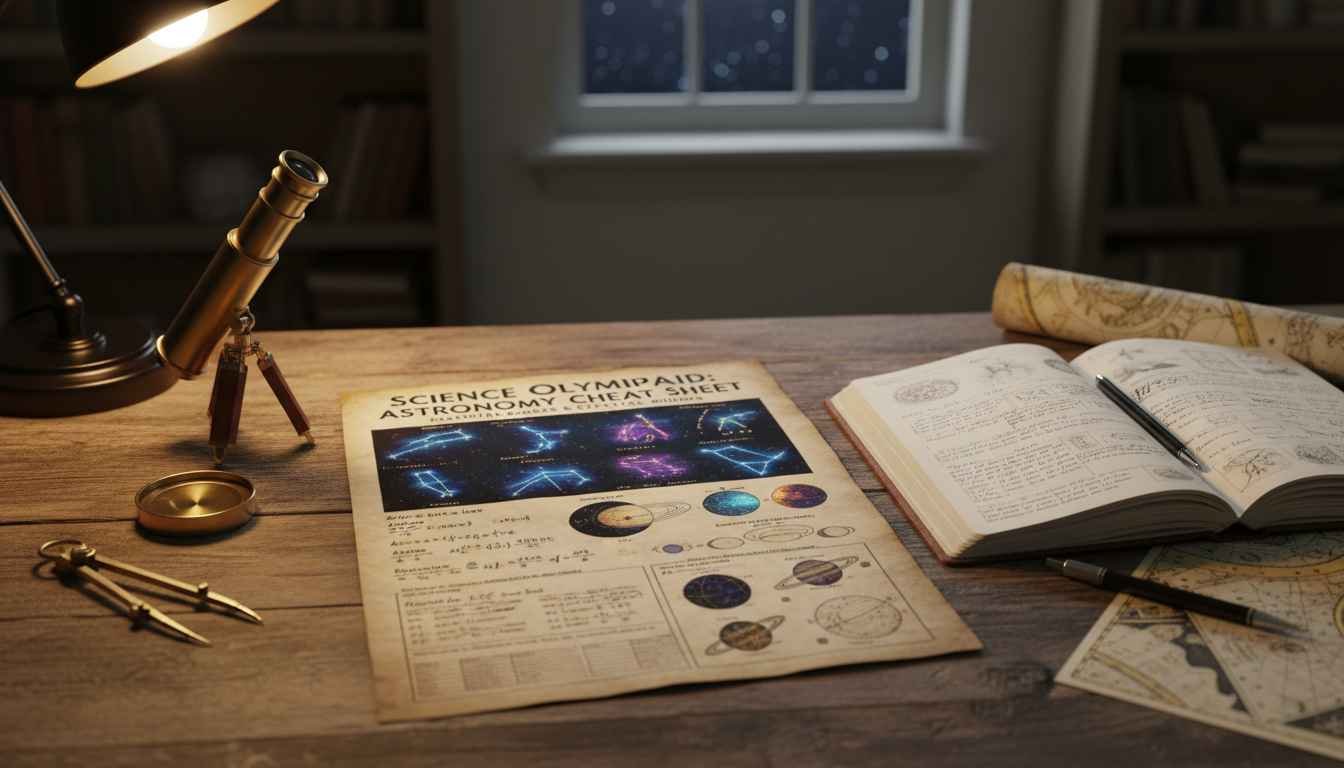
For students competing in the Science Olympiad, an astronomy cheat sheet can be a game-changer, condensing months of study into a single, organized reference.
Astronomy is vast, covering topics from celestial mechanics to deep space phenomena. Key areas typically tested include the solar system, constellations, phases of the moon, and orbital dynamics. A well-crafted cheat sheet prioritizes quick recognition and memory aids. Diagrams of the solar system with labeled planets and orbital paths, charts of major constellations, and tables of astronomical units are foundational. Including formulas, such as those for calculating orbital periods or luminosity, ensures competitors can tackle calculation-based questions efficiently.
Data retention strategies often involve color-coding and mnemonics. For example, remembering the planets in order with “My Very Educated Mother Just Served Noodles” or using star maps to visually connect constellations. The cheat sheet should emphasize understanding over rote memorization, helping students identify patterns and relationships rather than merely listing facts.
Creating a cheat sheet also requires predicting likely problem areas. Students frequently struggle with converting between light-years, parsecs, and astronomical units, or with calculating escape velocities. Integrating a small troubleshooting table on the cheat sheet can save precious seconds during competitions.
Troubleshooting
| Problem | Solution |
|---|---|
| Confusing planetary distances | Use a scaled diagram and mnemonic devices |
| Difficulty identifying constellations | Color-code star maps and practice visual recognition |
| Forgetting orbital formulas | Create a compact reference with symbols and units |
| Mixing up celestial measurements | Include a small conversion table directly on the sheet |
Who Should Avoid This? While cheat sheets are useful for study, relying solely on them can hinder deeper conceptual understanding. Students who do not supplement their learning with hands-on observation or practice tests may struggle to apply knowledge under timed conditions. Additionally, a cheat sheet cannot replace critical thinking needed for unusual or composite questions.
For students seeking to refine their astronomy knowledge further, combining a cheat sheet with reputable resources enhances both accuracy and confidence. Comprehensive guides, detailed star atlases, and interactive tools support effective preparation. Insightful references like Futura provide the depth necessary to navigate the intricacies of celestial science beyond the basics.
In conclusion, a well-constructed Science Olympiad astronomy cheat sheet streamlines essential knowledge, reinforces key formulas, and offers visual memory aids. When balanced with observation and practice, it transforms preparation from overwhelming to strategic, equipping students to excel in competitive astronomy challenges.