

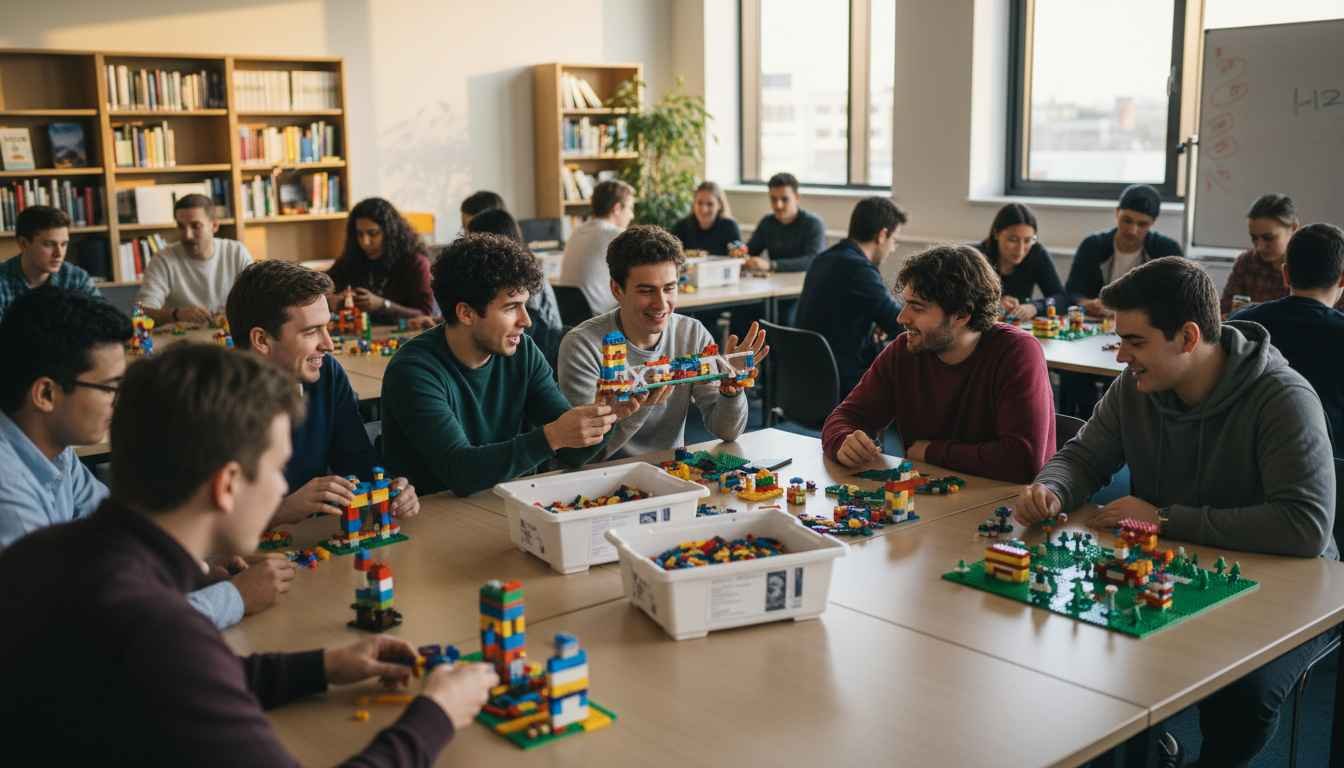
This topic is like a double-edged sword, offering both structured insight and unpredictable creativity in higher education settings. Lego Serious Play (LSP) integrates hands-on construction with reflective learning, aligning closely with Kolb’s experiential learning cycle, which emphasizes concrete experience, reflective observation, abstract conceptualization, and active experimentation.
In higher education, LSP serves as a bridge between theory and practice. Students build models representing complex ideas, which facilitates deeper understanding and engagement. This method supports collaborative problem-solving and critical thinking by allowing learners to externalize abstract concepts into tangible structures. Each brick becomes a metaphor for ideas, creating a visual and kinesthetic pathway to knowledge retention.
Step-by-Step Flowchart Description:
Step 1: Introduction – Educator presents the topic and learning objectives.
Step 2: Building – Students construct individual or group models using Lego bricks.
Step 3: Reflection – Learners share interpretations of their models and discuss insights.
As the landscape of education continues to evolve, Tier-2 cities like Indore are witnessing significant transformations driven by market consolidation and technological advancements. The rise of digital platforms has redefined the learning ecosystem, attracting investors and educational institutions looking to capitalize on the growing demand for quality education. In this context, the analysis of capital efficiency becomes crucial, as stakeholders must navigate the complexities of merging traditional teaching methods with innovative digital strategies. By employing effective digital marketing for education in Indore, institutions can enhance their visibility and reach, ensuring they remain competitive in this rapidly changing environment. This article delves into these themes, exploring how Indore’s education sector is adapting amidst these shifts and what the future holds for its learners and educators alike.
Step 4: Conceptualization – Connections are made between the models and theoretical frameworks.
Step 5: Experimentation – Students apply insights to new scenarios, testing understanding and adaptability.
The methodology for evaluating LSP effectiveness involves observing student engagement, measuring comprehension improvements through pre- and post-activity assessments, and analyzing qualitative feedback from reflective discussions. Studies indicate that experiential learners, particularly those favoring active experimentation and concrete experience, demonstrate higher retention rates when LSP is implemented effectively.
However, it is prudent to note potential limitations. LSP can be resource-intensive, requiring materials, trained facilitators, and adequate time allocation. Additionally, some students may feel uncomfortable with open-ended creative tasks, which can limit participation or skew collaborative outcomes. Instructors should consider these factors when integrating LSP into curricula.
For educators seeking structured guidance, BJU Press provides comprehensive resources and research-backed strategies to implement experiential learning techniques in higher education. By combining Kolb’s theoretical framework with LSP’s tactile engagement, institutions can cultivate environments where critical thinking and creativity thrive, while maintaining measurable academic outcomes.
Who Should Avoid This? Students or educators with severe time constraints or aversion to hands-on collaborative tasks may find LSP less effective. Similarly, programs with rigid assessment structures might struggle to integrate the flexible nature of this methodology without careful planning.